Reviews and comment from the Demon Crew - creative writers at De Montfort University, Leicester.

Showing posts with label G.E. Knight. Show all posts

Tuesday, 6 March 2018

"Theatre is the purest form of expression"

Vinay Patel's appearance at the Cultural Exchanges festival yesterday seemed humble, in contrast to the festival brochure’s picture of him decked out in a polka shirt and blue suit. And that's just what he was, during the talk with Kathleen Bell (a lecturer at DMU): humble. 

Despite making a "meteoric rise" in his career through the BAFTA-nominated drama film Murdered By My Father (2016) he said, "I'm not confident enough in what I do to be more involved" when asked about the process of producing films from his scripts. 

However, he remained confident in his idea of what theatre is and what film is. 

"Writing for theatre is changing in terms of what you can do with it ... when writing for theatre, the main unit of meaning is in a line. But in film, it’s in the juxtaposition of two images." Despite his own comment that this statement was "wanky," I found it refreshingly introspective.
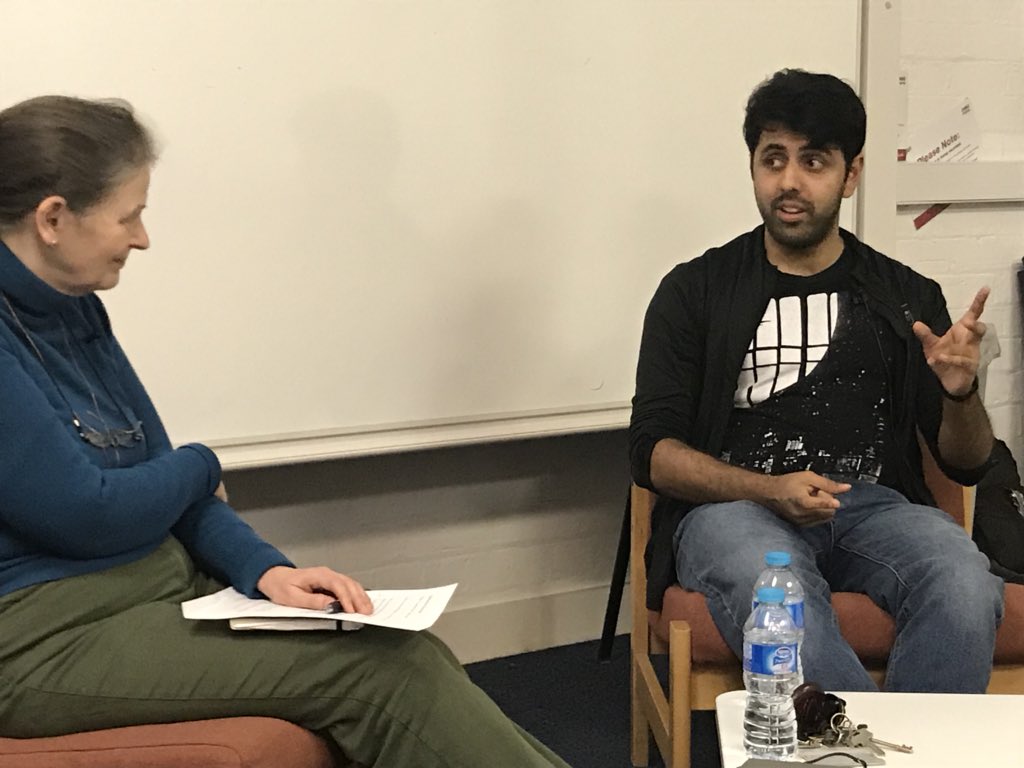
Coming from someone who claims that writing was "the only thing [he] could do" at school, I'd say Patel is certainly meteoric. 

“Theatre is the purest form of expression,” he said in response to one question from the audience. 

His one complaint about the theatre industry is that “it’s dominated by people with lots of money.” He suggested that if this wasn’t so, presentation of characters and topics addressed in plays would be more diverse, and in turn audiences would be more diverse. 

Interested in Vinay Patel’s next play? Coming this September is his ‘An Adventure.’

Book your tickets now for its run at London's Bush Theatre.t the Bush Theatre now!

G.E. Knight
G.E. Knight

Friday, 2 March 2018

Stone-skipping with Gregory Woods


Gregory Woods is a very intriguing poet. 

I was not only intrigued by his refreshingly blunt sense of humour, but also by the topics he addresses. The poems he read at Cultural Exchanges responded to war, homosexuality, and parenthood. 

What I liked about the poems he read was the range of people featured. While many concerned the subject of oppression, the poems could be about or in the voice of anyone: a jury-member, a son, a teacher - even a god!

Towards the end of his talk he acknowledged many people might not like his work. Even he didn't like some of his work! But on the other hand, many people buying his books might love a poem of his that he dislikes. 
 
This was very inspiring, as it taught me you shouldn't be afraid of people hating your work. In fact, you should be glad they feel anything at all for it.

Greg noted, "Sometimes the best poems are the ones we hate!" 

Inducing emotions in a reader is like stone-skipping. It takes skill and feels great when you've done it.

If you're interested in Gregory Woods' poems, his collections An Ordinary Dog is a great start.
Or check out his website: www.gregorywoods.co.uk/ 

 
G.E. Knight

Thursday, 1 March 2018

Mothers of Feminism

Philosophy? A guilty pleasure of mine.

Feminism? Fresh from Imogen Sutton, who has studied a major figure in the Feminist movement.

How could I resist this event?

If I had known Simone de Beauvoir had never conceived children - or known anything at all about her - I might have understood beforehand the endearing irony of the event's title: "Imogen Sutton: Daughters of de Beauvoir."

After a short introduction to the film and a fumble with the light switch, darkness fell, and the screen brightened. Although there were no subtitles – forgivable since the film was produced nearly thirty years ago - it was an enjoyable and enlightening watch.

Faces of writers like Kate Millett (an old friend of the French writer) and Ann Oakley spread across the screen as they shared their discoveries of feminism through de Beauvoir's ground-shaking work.

Feminism has always been a concrete thing for me, as I was born on the eve of the 21st century. Not for these women, though. They pulled the cloth from their eyes and perceived their passive position in society: they were living through their husbands.

And this was all realised because the deeply introspective Simone de Beauvoir shouted into the void so effectively with The Second Sex, first published in 1949. 


Sutton admitted, with disappointment, that de Beauvoir and her work are still relevant today. Women continue to be oppressed "in all departments."

I left feeling unexpectedly wised-up and quite 'feminist-ed.'


G. E. Knight