Reviews and comment from the Demon Crew - creative writers at De Montfort University, Leicester.

Showing posts with label Stuart Price. Show all posts

Thursday, 2 March 2017

Stuart Price's Revolution?

I wasn't sure about what to expect from Stuart Price's lecture One Solution - Revolution? Beyond populism and neoliberal visibility. However his talk, interspersed with stills and video clips, held my attention to the end.
 

The talk covered populism, democracy and political issues from roughly 2011 to the present day. It examined personalities who created revolutionary movements as well as classes which did the same and this gave us the chance to explore a range of views about political issues in today's society. Whether his topic was Brexit or the election of Donald Trump,Stuart Price managed to give his audience a new view on these questions. Students who weren't familiar with aspects of contemporary politics gained much - as did well-informed audience members who took the opportunity to advance their views.

After an hour,  Stuart Price ended his talk with "I'm sorry I went 2 minutes over the time", but he shouldn't be too worried about that. The mixture of humour and serious political issues was so interesting and enriching in terms of knowledge that I could have stayed one or two hours over the time.
 
 
Marie Ana

Monday, 9 March 2015

Sci-Fi - a week of reflection

It's been more than a week since, I along with many other members of the university and general public, listened to Professor Stuart Price's lecture at Cultural Exchanges. Unlike many of the attendees there I didn't know a lot about what I was about to listen to, but the title of the lecture (Violence, Knowledge, Repetition) interested me enough to book a seat.

I decided to hold off on reviewing this event in order to see how much of it really sunk in after time had passed and I am pleased to report that I still have fond thoughts of the lecture. What's more, the knowledge I gained has indeed sunk in. 

One thing in particular that sticks in my mind is, as the title suggests, how important and commonly used repetition is within cinema. I have never thought about how similar some scenes are in different movies. Indeed, Price showed us two different movies using the same shots, angles and references to each other. He talked to us about why this is what we recognise within cinematography. I certainly learned a lot about something I knew very little about before.

At the end of the lecture, the professor asked us out of interest if the people listening were Film students and when he found out that some were not, he smiled, almost surprised. I smiled too, at the surprise that was the delight of this lecture. Until next year, Professor..

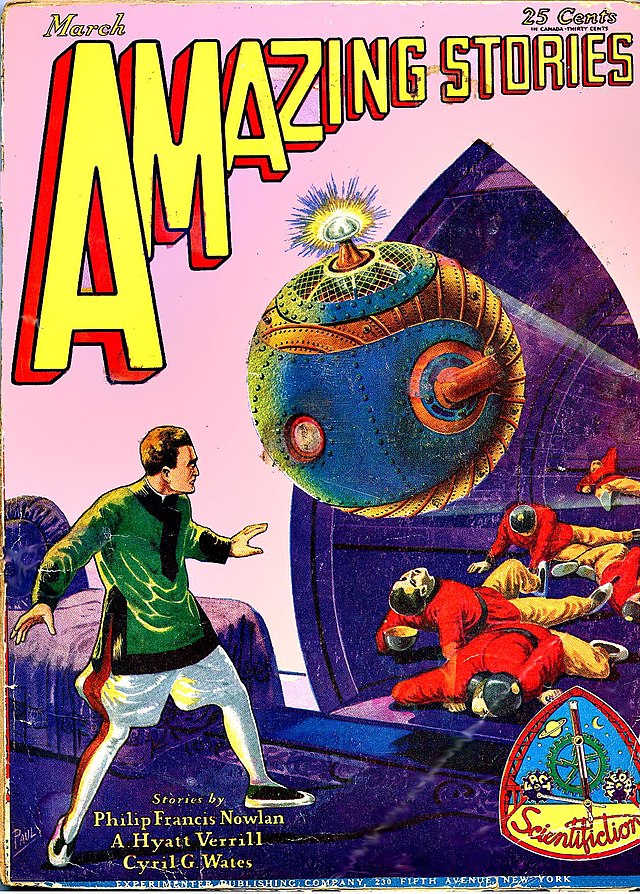
"Amazing Stories March 1929" by Published by Experimenter Publishing Co. - Scanned cover of pulp magazine. Licensed under Public Domain via Wikimedia Commons - http://commons.wikimedia.org/wiki/File:Amazing_Stories_March_1929.jpg#mediaviewer/File:Amazing_Stories_March_1929.jpg

Lewis Bagshaw

Dystopia now

"Mockingjay filming district two Tempelhof airport Berlin 02" by Lienhard Schulz - Own work. Licensed under CC BY-SA 3.0 via Wikimedia Commons - http://commons.wikimedia.org/wiki/File:Mockingjay_filming_district_two_Tempelhof_airport_Berlin_02.jpg#mediaviewer/File:Mockingjay_filming_district_two_Tempelhof_airport_Berlin_02.jpg
 

Professor Stuart Price's lecture on sci-fi alluded to a wide array of tropes that we see in most Hollywood Sci-Fi blockbusters, ranging from gender stereotypes to the protagonists’ common loss of identity.

Alongside these themes was an underlying message in the lecture that stood out to me. The point that Professor Price made is that cinema isn’t portraying a dystopian future in these action sci-fi movies. It’s actually a dramatization or a cinematic portrayal of modern day life itself.

Are we already in the beginning stages of what we call a dystopian future? Was film director Alfonso CuarĂ³n right in saying that “The tyranny of the 21st century is called democracy”?

Either way, I was fortunate to hear Professor Stuart Price discussing these important topics and sharing his insights.


Sam Ellison

Violence, knowledge, repetition

What can be better than spending an hour in a darkened room listening to a guy talk about Science-Fiction movies? Well, a lot, to be honest, but it’s still a pretty decent way to kill an hour of your time if you’re a total Sci-Fi nerd like I am.

Professor Stuart Price has A LOT to say about Science-Fiction cinema - particularly, as the title of the event suggests, about Violence, Knowledge and Repetition in Science-Fiction cinema. His observations on the narrative themes commonly found in Sci-Fi stories - repetition, where characters experience the same situation over and over again (evident in such films as Edge of Tomorrow and Source Code) and knowledge (evident in such films as Minority Report) - were both fascinating and unsettling. Why do Sci-Fi storytellers do this? What is the reason, the meaning, behind such repetition? Why is knowledge so important?

As both a student of Media Studies at A-Level, and of Film Studies here at DMU, I found I was able to understand quite a lot of Professor Price’s lecture. His mentioning of de Saussure’s Binary Opposition theory, Propp’s Character theories, and Todorov’s Equilibrium theory (concepts that propose the media follows a particular set of narrative restrictions) in fact made the lecture feel very reminiscent of my usual classes. And of course, I was familiar with all the films Price took examples from.

All in all, I found Professor Price’s talk both enlightening and enjoyable.


River Apparicio

Wednesday, 2 March 2011

We're nice - and not after your money

Double-checking my booked events last night, I was surprised to find I had double-booked. What a shame I had to choose!

I chose to see Dr Stuart Price's Micro-Ideology lecture, and I believe I chose correctly.

Though advertising has always interested me, I was initially at some disadvantage in understanding the lecture, finding myself a little out of my depth with some of the terminology. Once we got going into the subject proper, though, I learned quite a few advertising tricks neither I nor, most likely, most people would have stopped to notice before.

Most particularly the way that, nowadays, companies make an effort to appear benevolent and friendly towards us, more so than in older times. They talk about all the good they're doing, speak to us directly, tell us how to solve our problems - while manipulating the truth to make that good seem greater, to pose the very problems they solve. Not to mention the times when their slogans devolve into pure nonsense.

And yet all this was delivered with a cheerful matter-of-factness, and no great burden of cynicism. Just watch out the next time you notice a radio or TV show 'sponsored by' a company - doesn't that endorsement tacked onto the end in some way make the whole programme an advertisement?


Louella Pritchard