Reviews and comment from the Demon Crew - creative writers at De Montfort University, Leicester.

Showing posts with label film. Show all posts

Wednesday, 27 February 2019

From home to Hollywood


Nita Harvey was imaginative, radiant and driven.

Before this Cultural Exchanges Festival I knew nothing of Nita - nor of her great-niece Ellen Nolan , but that's another name I won't forget. Throughout this capsule collection we were not only spectators to a celebration of family history, but were presented with insightful narratives from both Ellen and Nita. Nita's contsant companion was the camera as we followed her adventure from the back gardens in suburban Golders Green to the rooftops of London theatreland on St Martin's Lane.

Nita's archive, curated by Ellen, is more than just photographs; it's a memoir of a woman finding her self-portrait, a relationship with the lens, an evolution of experimentation to expectation. It makes the viewer witness to the development of playfulness and theatricality to awareness and femininity of a young actress of the 1920s. Then comes a transition to brutal objectification in Hollywood depicted through a 360-degree silent video scanning her body - and the sense of playfulness is lost. But Nita's friednship with the camera persists and remains true until the end.

'She is still beautiful'

I left that lecture theatre inspired by Ellen, who took seven years to understand what she needed to do with the archive, maintaining control by funding her own work. Ellen and Nita make me want to produce my own project, influenced by Nita’s artistic flare and the emotions she evokes even as she poses for her early photographs with domestic objects such as pillows, piano stools, beads and bedsheets. Ellen's Instagram is flooded with ideas she's experimenting with, including elements from the archive.


s.m.blair

Tuesday, 6 March 2018

Visible Bits, Audible Bites - year 9

For the ninth year in a row, Phoenix Cinema held the Cultural Exchanges event Visible Bits, Audible Bytes.
 
As a joint honours film studies and writing student, I spend a lot of time in the Phoenix, and know that, as an independent cinema, it usually holds interesting and stimulating events. 

This event was hosted by De Montfort University's very own Professor Bret Battey and consisted of seven pieces of work: Cyclic from Numbercult and Max Cooper, Nuées by Myriam Boucher, Virtual Actors in Chinese Opera by Tobias Gremmler and the GuoGuang Opera Company, Estuaries 3 by Bret Battey, Scan_0.1 by Giorgio Bertinelli, Vacuum by Francesco Martí, and finally, Jean Piché's thirty minute long piece Threshing in the Palace of Light. 

I found every single piece extremely captivating and emotive, and I really don't think that I could say that I have ever experienced any piece of art that is in any way similar to any of the works I saw at this event.
 
The most emotive for me would have to be Nuées by Myriam Boucher, as I found it genuinely scary and anxiety inducing, due to its loud, jarring, repetitive sounds and the disturbing crossing over of images of birds flying. 

My favourites out of all of the clips, however, were definitely Virtual Actors in Chinese Opera by Tobias Gremmler and the GuoGuang Opera Company and Estuaries 3 by Bret Battey.
 
Battey's piece was rather soothing, and visually reminded me of what one would envision the feeling of a sneeze to look like: fuzzy and lingering. 
 
Virtual Actors in Chinese Opera was really interesting to me, as I love dance and it was so captivating to see such wonderful colours and shapes moving alongside one another so gracefully to create a sense of a character.

I would definitely recommend anyone who is interested in the arts and forms of creativity in any way to attend the tenth event in this series next year, as I think everyone could take something from it.


Paige Nicole

Tuesday, 28 February 2017

People against the machine

 After a string of classic movies like Kes, Ken Loach brings us the deeply moving I,Daniel Blake. This is the film that earned Loach his second Palme d'Or award as well as a BAFTA for the outstanding British film to 2016.

I, Daniel Blake is underpinned by the idea that the benefits system is not jusr a “monumental farce” but that the system is also being used as a political weapon to discourage people from claiming the benefits they need and to which they are entitled. Even though Daniel Blake has a heart condition which prevents him from working, Benefits Office staff him to apply for Job Seekers Allowance and to keep applying for jobs which he can't take, on medical advice. 
 
This film isn't just about politics. It's also about people and their personal relationships. As the system tries to reduce people in need of help to mere numbers, there's an emerging sense of community as the less fortunate and those who have been abused by the system pull together to oppose the featureless machine that threatens to cruch them. 

Thomas Jack

Saturday, 25 February 2017

Daniel Blake in Leicester


I, Daniel Blake poster. Obtained from the
distributor and posted on 22nd November 2016 to:
 https://en.wikipedia.org/wiki/I,_Daniel_Blake.
 I'm a film student and when I, Daniel Blake was released neither my lecturers nor my fellow students would stop talking about it.

Ken Loach is a well known for his realist films that shine a light on real people with real problems. His past successes include classics such as Kes (1969) and Looking for Eric (2009). After watching the trailer and seeing its social realist themes I was eager to see it.  
 
Many people I have spoken to have seen the film and speak highly of it. This can be reflected with the reviews and ratings on sites such as Rotten Tomatoes where it gained the very high score of 93% from its audience. The film also won the Palme d'Or at Cannes as well as the BAFTA award for Best British Film.

After all of this success I, Daniel Blake is finally coming to De Montfort University in a special afternoon screening as part of the Cultural Exchanges Festival.. Tickets are currently sold out, but you may want to check by email or linger at the door in the hope of returns.

Chardae Green

Tuesday, 1 March 2016

Bollywood tales and Alpine fantasies

As a film fan and eager to learn more about Bollywood, I made sure to leave home early so that i would arrive at Dt Monia Acciari's lecture in time. As a result I arrived half an hour early; I was the first to reach the hall and for the following minutes sat awkwardly in silence while Dr Acciari prepared for her presentation. Luckily the room soon filled up and people of varying ages occupied the seats around me. It was nice to see this event get the attention it deserved.

Dr Acciari showed clips and trailers from a range of Bollywood and independent Indian films. I've now added Jadoo, Hal Ho Naa Ho, Farz, Rockstar and Queen to the list of films I want to watch in my spare time.

It was also particularly fascinating to learn how Switzerland became a popular location in Bollywood films. Initially the film's story would be set in India but would cut to Switzerland for fantasy or daydream scenes. Eventually this expanded until long episodes or even whole films were set in Switzerland or other European countries. 

All in all, I enjoyed this event a lot!
 
 
Hayley Phythian

Monday, 9 March 2015

Sci-Fi - a week of reflection

It's been more than a week since, I along with many other members of the university and general public, listened to Professor Stuart Price's lecture at Cultural Exchanges. Unlike many of the attendees there I didn't know a lot about what I was about to listen to, but the title of the lecture (Violence, Knowledge, Repetition) interested me enough to book a seat.

I decided to hold off on reviewing this event in order to see how much of it really sunk in after time had passed and I am pleased to report that I still have fond thoughts of the lecture. What's more, the knowledge I gained has indeed sunk in. 

One thing in particular that sticks in my mind is, as the title suggests, how important and commonly used repetition is within cinema. I have never thought about how similar some scenes are in different movies. Indeed, Price showed us two different movies using the same shots, angles and references to each other. He talked to us about why this is what we recognise within cinematography. I certainly learned a lot about something I knew very little about before.

At the end of the lecture, the professor asked us out of interest if the people listening were Film students and when he found out that some were not, he smiled, almost surprised. I smiled too, at the surprise that was the delight of this lecture. Until next year, Professor..

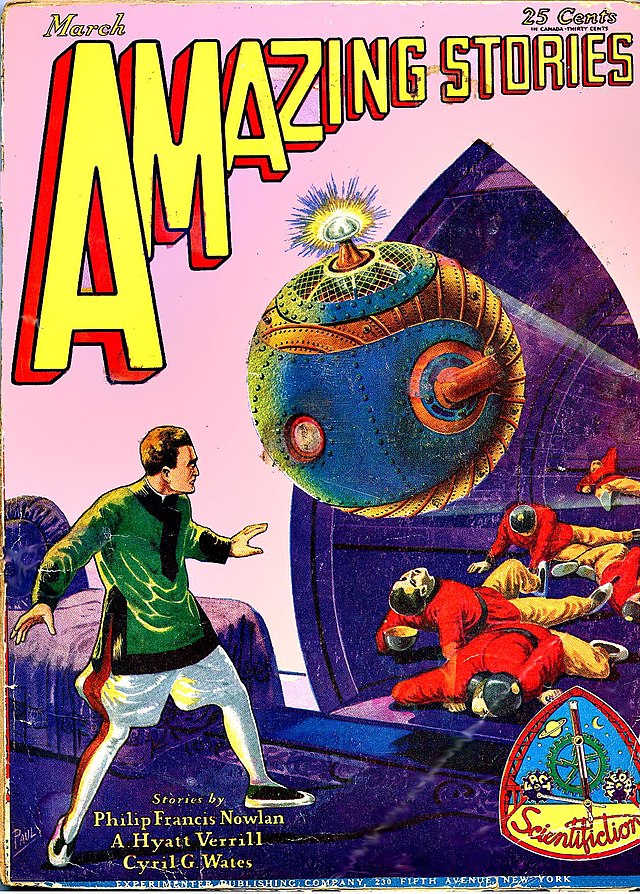
"Amazing Stories March 1929" by Published by Experimenter Publishing Co. - Scanned cover of pulp magazine. Licensed under Public Domain via Wikimedia Commons - http://commons.wikimedia.org/wiki/File:Amazing_Stories_March_1929.jpg#mediaviewer/File:Amazing_Stories_March_1929.jpg

Lewis Bagshaw

Dystopia now

"Mockingjay filming district two Tempelhof airport Berlin 02" by Lienhard Schulz - Own work. Licensed under CC BY-SA 3.0 via Wikimedia Commons - http://commons.wikimedia.org/wiki/File:Mockingjay_filming_district_two_Tempelhof_airport_Berlin_02.jpg#mediaviewer/File:Mockingjay_filming_district_two_Tempelhof_airport_Berlin_02.jpg
 

Professor Stuart Price's lecture on sci-fi alluded to a wide array of tropes that we see in most Hollywood Sci-Fi blockbusters, ranging from gender stereotypes to the protagonists’ common loss of identity.

Alongside these themes was an underlying message in the lecture that stood out to me. The point that Professor Price made is that cinema isn’t portraying a dystopian future in these action sci-fi movies. It’s actually a dramatization or a cinematic portrayal of modern day life itself.

Are we already in the beginning stages of what we call a dystopian future? Was film director Alfonso Cuarón right in saying that “The tyranny of the 21st century is called democracy”?

Either way, I was fortunate to hear Professor Stuart Price discussing these important topics and sharing his insights.


Sam Ellison

Violence, knowledge, repetition

What can be better than spending an hour in a darkened room listening to a guy talk about Science-Fiction movies? Well, a lot, to be honest, but it’s still a pretty decent way to kill an hour of your time if you’re a total Sci-Fi nerd like I am.

Professor Stuart Price has A LOT to say about Science-Fiction cinema - particularly, as the title of the event suggests, about Violence, Knowledge and Repetition in Science-Fiction cinema. His observations on the narrative themes commonly found in Sci-Fi stories - repetition, where characters experience the same situation over and over again (evident in such films as Edge of Tomorrow and Source Code) and knowledge (evident in such films as Minority Report) - were both fascinating and unsettling. Why do Sci-Fi storytellers do this? What is the reason, the meaning, behind such repetition? Why is knowledge so important?

As both a student of Media Studies at A-Level, and of Film Studies here at DMU, I found I was able to understand quite a lot of Professor Price’s lecture. His mentioning of de Saussure’s Binary Opposition theory, Propp’s Character theories, and Todorov’s Equilibrium theory (concepts that propose the media follows a particular set of narrative restrictions) in fact made the lecture feel very reminiscent of my usual classes. And of course, I was familiar with all the films Price took examples from.

All in all, I found Professor Price’s talk both enlightening and enjoyable.


River Apparicio

'a social war against all'

The short film, The Condition of the Working Class, sets out to explore the differences between working-class Britain in 1844 as described by Friedrich Engels and working-class Britain of today.

I was shocked, yet not surprise,d at how static this country has remained. Britain is bound by tradition, scared of change and just as in 1844, in the midst of a 'social war against all'.


Like most present, I found the film funny, charming and, most importantly, honest, conveying the struggle of hard-working people in this country.

Once again the poor are getting poorer and the rich are getting richer. So, when will we stop living in the past, stand up and be counted? When will 1844 be a distant memory?


Charlotte Batey

Sunday, 1 March 2015

The Monochrome Spy

A mysterious man walked onto the stage in front of the screen at the Phoenix Cinema, and introduced his latest work. It was obvious that he was both nervous and excited as he thanked everyone for attending. Then the screen flickered. 

What followed was an all-action, satirical spy film set in 1964. This tongue-in-cheek nod to the famous television series' of the 1960's, had all the expected genre conventions: a narcissistic Bond-esque protagonist named Guy Boulton, a Soviet villain, a murder-mystery, a beautifully oblivious female called Elizabeth Landers; and the omniscient American organisation controlling the entire thing - named, rather aptly, Control. 

It ran for an impressive 1 hour 11 minutes, after which three men took to the stage for a discussion. They introduced themselves as Dick Fiddy, Tim Meadows, and Paul Gosling, the creator of the project. The discussion that followed revealed that Gosling aimed to make his movie emulate the black and white 35mm shows, such as The Saint and Dangerman. 

The Monochrome Spy had been an idea for 8 years, filmed entirely in Leicester with a budget of £1300 and all of the constraints that one would expect. And it was, at least in my opinion, a raging success. It was amusing without being insulting, engaging without being tedious; and the acting talent was far beyond any expectations I had when learning that it was an independent film.

The event ended with a quote from Fiddy regarding the secret of scriptwriting: "Bottom to chair, pen to paper!"


Hayleigh Lynch

Tuesday, 24 February 2015

Opinions that need to be heard


The Condition of the Working Class is about a group of northerners devising and performing a piece of theatre based both on their personal experiences and the book The Condition of the Working Class in England in 1844 by Friederich Engels. It's a very well put together film that educates the audience about life now and in the mid-nineteenth century. This film provokes questions about the way people are being treated now why there is still such a large class divide.

I'm not clear on the aim of this film or how it might change the world; however if it is to tell the majority what is being hidden by the media, I definitely feel more informed.


Of course looking into the working class Britain from the 1980s onwards you can't help but walk straight into Margret Thatcher. The film fully addressed that and even went as far as going out onto the streets of Manchester to ask the public exactly what they thought of her, and of working-class life in general. However we were told later during the Q&A that quite a few people were afraid to talk to the camera for fear of losing their jobs. This leads me to asking those in power in Britain, why should anybody be afraid to have an opinion and to state it?


Abbiee Henesy

Monday, 23 February 2015

Engels today

Today I attended the screening of The Condition of the Working Class and I thoroughly enjoyed it. I find it admirable that the directors and actors used a book written by Engels in the 1800s and related the theories to contemporary society. Some of the points from that book are still very relevant in modern times.

In this production, the experiences of working class people are shared. This is quite rare which implies that there are still some issues in society that are ignored.

Some of the actors spoke about accents and how this can be a barrier, especially for aspiring actors. As a man with quite a strong northern accent, I can definitely relate to that particular problem.

The Q&A session held at the end of the screening gave guests the opportunity to ask the directors questions about the production. This was a useful way to consolidate the knowledge gained from the film.

I would thoroughly recommend watching this film as it is both enjoyable and educational.


Harry Singh Panesar

Thursday, 28 February 2013

Student films - definitely not amateur

A still from... actually, it says in the image. By Sammie Williams.

I think one of the things that has struck me most about the Cultural Exchanges festival is the simply fantastic output from DMU's creative students. Whether it was the Fine Art department's Art Auction or Creative Writing's own showcase pieces the week has been bubbling with originality and vision. But the event that has struck me most was the 1 too 3 showcase, an exhibition of video pieces from across the university.

And quite frankly, the films on show were stunning. The pieces on display ranged from the playful intimacy of Red Wine Hangover to the unsettling surrealism of the Idiosyncracies dance video and seemed to cover everything in between.

What with drama, comedy, horror and a good dose of fantasy, the films showed eager young creators at their best - doing what they love and getting to show the end result to the public.

Two pieces really stood out for me.  One was Mechanical Angel, a strange mash-up between science fiction and a haunting music video.  It put me very much in mind of The Cabinet of Dr Caligari and of course the Expressionism movement that inspired it.
 
The other was Sean Goldthorpe's piece that depicted a relationship in reverse - sometimes literally - from the unfortunate break-up to the couple's chance meeting. The cinematography in this piece was wonderful, including slow, lingering shots to set the rather gloomy mood and even using a black screen to divide the couple, reflecting the distance between them.

All the videos mentioned here are going to be on display again tomorrow throughout the day and are totally free of charge, I highly recommend checking them out at Newarke Houses Museum (10-6, Friday 1st March).

 
Lex Griffiths

Friday, 22 February 2013

Screen success

When I finally came to pick the 3 events I was inclined to attend, I became rather over-excited and signed up for 6.  But top of my list is the discussion with author and screenwriter Andrew Davies on Wednesday 27th February. 

Davies  will be discussing his work with Deborah Cartmell and Yvonne Griggs (DMU).  These include his BAFTA-nominated adaptation of Charles Dickens' Bleak House, as well as television versions of Pride and Prejudice, Sense and Sensibility and Vanity Fair. He also collaborated on the screenplays for both Bridget Jones films. His latest work, period drama Mr Selfridge, is currently being aired.

I'm looking forward to hearing from one of the UK's most critically acclaimed screenwriters and learning how he works.


J.Wedgbury

Thursday, 29 March 2012

Srtipping away excess


A short film written and directed by Adrian Lester (Mickey from BBC One's Hustle) brought tears to my eyes. A moving tale of a family having to make life-changing decisions, Adrian's new venture into directing went down a storm with all who came to his Thursday night screening.

Described as a perfect "marriage of experience and talent", Adrian, along with the two producers of Of Mary, wife Lolita Chakrabarti (established writer and actress) and Rosa Maggiora (acclaimed Theatre Designer) shared with the audience the highs and lows of working on this piece.

When asked why he had taken the leap from acting to directing, Adrian cracked a smile towards the audience and stated "One day I was combing my hair - and found a grey one..." He showed the audience that not trying everything wasn't an option for him as he delved into his range of past achievements from Hollywood film to Shakespeare on stage.

Concentrating mainly on the hidden detail associated with the short film, he compared the editing process to that of a sculptor saying you must "take away the excess until all you have left his the bare essence". He also went on to say that his biggest fear as a director was knowing that an audience "might not get it".

All three went on to share advice and future plans with the audience showing themselves to be experienced (as well as humorous) individuals which made an already amazing evening an even greater success.


Celia Wilding

Of darkness and tissues


"It's hard to move an audience in twenty minutes." Adrian Lester was as humble as pie in the Q&A session he gave after the screening of what he described as his "first effort at directing." The film Of Mary takes its name from a poem by John Eclair.

As the credits rolled the silent theatre audience rubbed its eyes and drew out tissues. I shan't be describing the plot in this review - it has to be experienced, and requires darkness, peace and concentration. What I shall say is that it's not anything you'll be expecting - it's better.

Adrian Lester, Lolita Chakrabarti and Rosa Maggiora working together as Lesata Productions have this year carved a deep and artistic notch in the tree of British film. They say they plan to go on and make feature lengths - personally, I can't wait.


Raegan Sealy

Wednesday, 29 February 2012

A movie that mattered

Directed by Basil Dearden in the early sixties, Victim was a pivotal movie in the campaign to repeal the laws against 'homosexual acts'. I would say it was the most courageous movie within Britain. Everyone involved with the film made sacrifices to gain rights for others.Truly remarkable.

The talk was given by John Coldstream. The event was only one hour long, but I am positive he manged to fit hours' worth of information into the allotted time. He gave a strong and thought-provoking talk on the film's treatment of homosexuality.The audience were fully engaged with him and eager to hear more.

Towards the end of his speech, he asked if members of the audience had any questions. One gentleman raised the argument that Britain has not changed a great deal since the time of Victim. He shared the sad fact of his partner passing away, and how he is continually treated in a shocking way by our society.

This event was more than just part of Cultural eXchanges. It was a discussion involving real people's emotions. It was everyone talking as one: Being Equal. It raised the continually avoided question: Has Britain really changed?

Debbie Tinsley

Friday, 24 February 2012

Getting me some culture, innit?

When I tell people I'm going to the Cultural eXchanges festival, those unacquainted with it often respond with a bemused look and a comment like, "Cultural what? What liiiiiiike... art and s**t?"

Well. Sort of. When I explain that actually, it's a whole week of dance, literature, poetry, films, with appearances from celebrities like Jamal Edwards, Murray Melvin, Gwyneth Lewis and Hustle's Adrian Lester for little or no money, people's expressions change.

Being a newcomer myself, I'm excited for next week. I've never been to a festival quite like this one, and I'm looking forward to seeing what happens when lots of creative types are thrown into one place at one time.

In a world where students are constantly told it's near impossible to get a job in media, art, writing, and so on, it will be interesting to see a group of successful people in these fields who have got these jobs, and to figure out how they did it.

To book for the events running Monday 27th Feb - Friday 4th March click here.


Natalie Beech

Murray Melvin

On Tuesday 28th Feburary from 6:30-7:30, Murray Melvin is coming to De Montfort to be interviewed about his work on both stage and screen.

An actor who has appeared in many different genres, Murray Melvin is a fascinating individual. Nominated for and winning many awards (in particular for A Taste of Honey), he is a highly-respected actor on film and stage. The list of actors and directors he has worked with is eclectic and impressive, boasting such names as Rita Tushingham, Ken Russell and Stanley Kubrick. Above all, he is known for his work with pioneering director Joan Littlewood at Theatre Workshop and is now the archivist of the Theatre Royal, Stratford East.

Murray Melvin has also appeared on TV screens for many years, in shows ranging from The Avengers and Petticoat Pirates to Torchwood In these, as in his stage and film work, he is a distinct and remarkable personality in the world of acting.


Tickets can be booked HERE.

Edward Spence

Saturday, 6 March 2010

Childhood hero, adult inspiration


When I was a child, my Dad sat my brother and me down and said: "You've got to watch this film, it'll change your life."

The film was Kes, and it changed my perception of the world. I knew then that the world wasn't just slow-motion romantic strolls and Transformers.

I have a strange built-in shyness around hero figures of mine. When Ken Loach entered the room, I wanted to drag him away and ask him millions of questions I knew nobody would want to ask him but me. Everybody has a different perception of the films Loach makes - that's why they are so brilliant.

Loach talked about his early years in television - a time that makes me insanely jealous. Can you imagine the BBC making those films now? The men in the suits would have heart attacks.

Politics are important to Loach, and play an important part in all his work. Some say his work is downbeat and miserable, but others - like me - believe that his work is full of hope and truth. You never feel cheated.

At 74 years of age, Ken Loach looks fit and strong and he talks with passion and gusto. I could have listened to him all night. If I become successful in my chosen medium, I may be able to battle that hero-worshipping shyness and do just that.


Daley James Francis


image sourced through wikimedia commons