Reviews and comment from the Demon Crew - creative writers at De Montfort University, Leicester.

Showing posts with label art. Show all posts

Wednesday, 27 February 2019

Engaging and exchanging art: the Baroda exhibition

Art and culture go hand in hand: colours, perspectives and influences, all entwined with a purpose: to make us see or feel something we might have otherwise been deprived of.

Why not take the afternoon off and, considering the lovely weather, stroll straight to the gorgeous Gallery of DMU? There you'll have the chance to enjoy The Baroda Exhibition.  

Fine Art students and staff from DMU and Maharaja Sayajirao University of Baroda, India, were involved in its creation. 

The artists, inspired by an exchange programme, have displayed their impressive work in the exhibition. Each presented piece has its own charm and each artist stirs a different kind of feeling in the viewer.

You can read about the artists’ experiences, admire their work and perhaps develop a new-found appreciation for art (if you don’t already have one) at the Gallery. 


The exhibition is open at any time of the day during the Cultural Exchanges Festival 2019.


Valentina Verba

Wednesday, 1 March 2017

An artist's affliction: Emma Stibbon in conversation

I came to the interview with Emma Stibbon as a complete outsider: I’d never heard of her, never seen her work. My only preparation was an intriguing paragraph in the Cultural Exchanges booklet. I left the event knowing more about Stibbon and her work than I do about Van Gogh. 

I left that talk a fan.

The set-up was simple: Stibbon and Theo Miller, her interviewer, sat at a small table at the front of the lecture hall, with just a table lamp for light. Overhead, a PowerPoint looped through a selection of photos of Stibbon and her artwork. It was simple, open, and intimate: a feeling mirrored in Stibbon’s speech and the warmth with which she answered Miller’s questions.

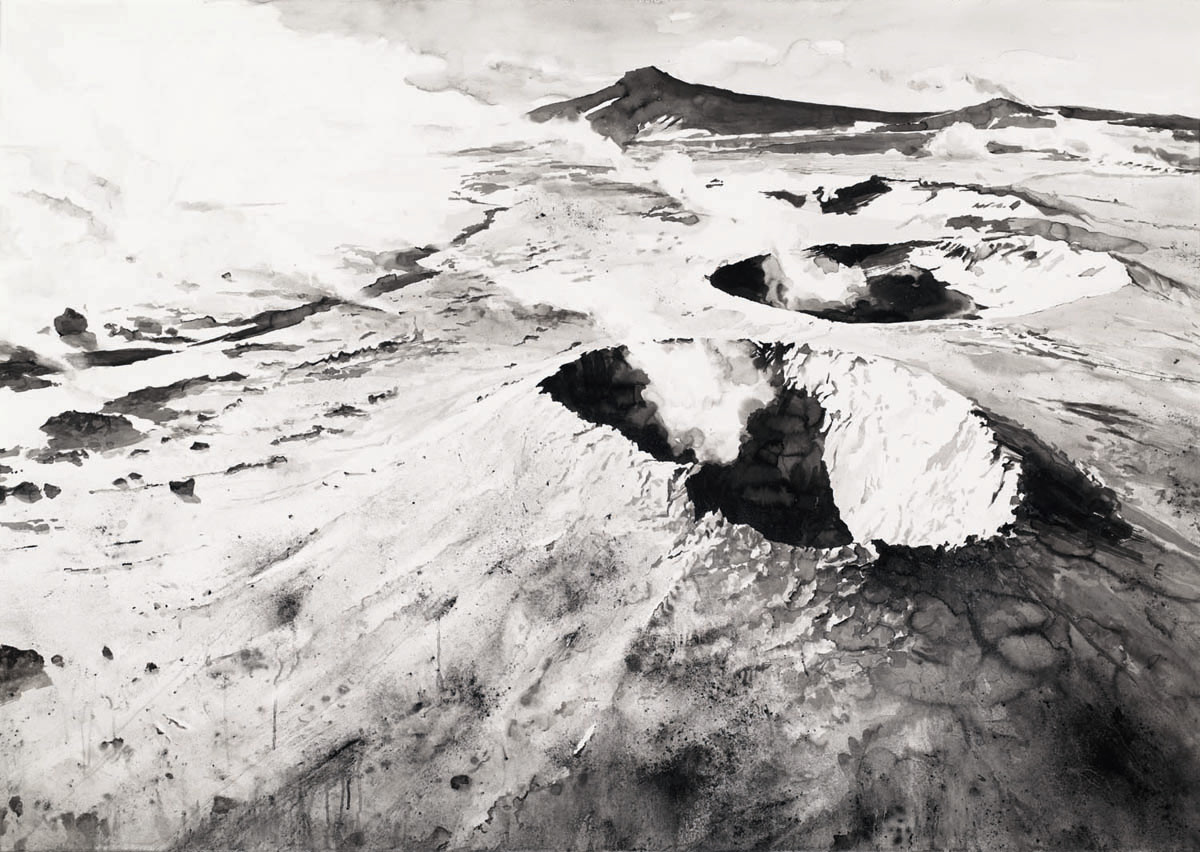
 Many of the early questions focused on Stibbon’s journeys around the world to study landscapes for her art: Rome, Berlin, Hawaii, and even Antarctica have made appearances in her striking monochrome artworks.

 More than once, an image would appear just as she was talking about somewhere she’d been or something she’d seen. A photo of Stibbon sketching the bleak Antarctic on a tiny boat showed up just seconds after she made an offhand comment about drawing in miserable cold places.

Honest and open, she invited us to enter her world, and made a genuine impression on me and many others. Of everything she said, though, nothing rang so true as her answer to Miller's question on work-life balance:
“It’s a compulsion, or even an affliction, to be an artist.”


Ben Woore

Driven to art: encountering Emma Stibbon


Image result for emma stibbon work
Emma Stibbon RA, Hverir, Iceland.
Photo taken from The Royal
Academy of Arts 


Plunging straight into the interview, Theo Miller asked Emma Stibbon what inspires her work. Her response immediately conveyed her personality as she explained that she's driven most by the urge to communicate.

Emma has always had a love of drawing and an interest in changing landscapes. Both are combined in her art.

"A lot of your work could be seen as quite dark, is this what you like to create?" a member of the audience asked. Stibbon continued by explaining that Berlin, a place which has been the source for many of her works, is a beautiful and exciting city, but like any other also has real traumas. Stibbon's work is a wake-up call.

Stibbon is currently in talks with project pressure, a charity that works with artists around the world. Their aim is to give audiences a wider understanding of the world. 

Meanwhile Emma's work continues to draw her to new places. She is  excited to at the prospect of exploring the Himalayas later this year.

Megan Louise

Saturday, 25 February 2017

Embracing art

The Fine Art Auction at Cultural Exchanges promises an array of artwork to grab your attention, some by current students and some by recent DMU graduates. 

 The students have worked day and night to prepare for this auction and all the money raised will be donated to the student Degree Show Catalogue Fund. This allows the students to reach their full potentials in future shows.

So come along to our all-new Vijay Patel Building at 6pm on 28th February. Marvel at the artists' creations and bid, bid, bid!

You can keep up to date with what our artists have been up to by clicking here!

The world of Fine Art is so varied that you are sure to find something that sparks your interest.

Come along, embrace your inner connoisseur, and support the artists of the future.

 
Kaitlan Baker-Smith

Fine art - I need fine knowledge

It's my lack of knowledge of fine art that has led me to book for Emma Stibbon's workshop.  I want to know more about the subject, not least because I've several friends who have studied it.

Emma Stibbon has a page on the University of Brighton website, where she now teaches. This gives a timeline of her exhibitions which led to her current international profile. The video above shows an example of her work when she explored the history of places - a project which involved a field trip to Antarctica.

Stibbon's awards for her work include one from the British School at Rome. I'm excited to learn more about both fine art and Emma Stibbon. I hope that afterwards I have a wider understanding of what it is my friends do.


Megan Louise


All Things Arty


(Source: dmu.ac.uk)


With the exciting Cultural Exchanges festival just around the corner, I decided it was time to take a look at the events on offer. Hosted by De Montfort University, the festival showcases a range of performance, art, literary discussion and much more. The event draws people from across the country and beyond and is a great opportunity for DMU students to watch, listen and take part. I was thrilled to see the variety of events in the programme.

What am I most excited about? As an aspiring writer, I'll be popping into as many poetry and writing events as possible, such as a talk with Nina Stibbe, and a session on writing short stories. I also thought, Why not see what other stuff Leicester has to offer? So I've booked onto a few visual arts events and I'm both curious and intrigued to see what awaits me.

The festival is nationally renowned, drawing large crowds and media interest each year. So next week I'll have my running shoes tightly laced and be bouncing from one event to another.

Don't take my word for it, why don't you come along and see the festival for yourself! Follow the link
here and book yourself in!

 
Dominic Gilmour

Tuesday, 1 March 2016

Arty goodness, with free champagne

Well, you know it’s been a good auction when there’s a bit of a bidding war…
I honestly thought that the gavel was going to get whiplash, what with the amount of offers going on.
There are a lot of fantastic artists at DMU (including my sister and her arty comrades), and I am super proud to have gone, to raise money for their degree show.
I even managed to get some arty goodness to brighten up my halls!
And one of the best parts was the complimentary champagne. You definitely can’t go wrong with free champagne.

My sister and her arty pals.
 Jenni Brooks

Tuesday, 24 February 2015

Hearing the dissenters

I staggered into Clephan 3.03 yesterday with some piece by Bach stuck in my head, not knowing what to expect. My first foray into De Montfort's 2015 Cultural Exchanges Festival was a talk by Dr. Michael Paraskos, entitled: "Mise en Abyme: Anarchism, Art & Theology". The talk began with him discussing the nature of art. What can be called art? What purpose does art serve? Interesting, nuanced questions that invite discussion. He then delved deeper into the philosophy and history of art, linking it to thoughts on Marxism & Anarchism.

When he was done he opened the floor to questions from the audience, and I, puzzled by some of his comments, asked him a question about Cultural Marxism. His response was solemn and full of hope. He spoke of being pleased, and surprised to be here. He spoke of being allowed to share his thoughts, and his opinions, views far from the mainstream in academia that he felt would normally be opposed. 

This is what the festival is about, hearing the voices of those whom you would normally never hear. The marginalised, the silenced, the dissenters. I was more than pleased to witness this talk, I was honoured, and I hope Dr. Paraskos returns next year.
 

Ciaran Lovejoy

Saturday, 22 February 2014

I think that I would be both correct and inoffensive to say that David Shrigley has been very lucky. He’s lucky to have been nominated for the Turner prize, and to have been on the fourth plinth in Trafalgar Square. He’s lucky to have found work as an artist, something notoriously difficult to do. The fact that he got a 2.2 for his degree in Environmental Art, which, apparently, you get “just for turning up” makes it all the more impressive. He’s also lucky to live in the UK, the only place, probably, to understand and appreciate his understated, quiet but excellent sense of humour.

At the same time, it doesn’t take much to see that he is, clearly, a brilliant artist. Perhaps not in the traditional sense: he debates the usefulness of being able to draw well, and has a strange, cartoonish, childish style. He seems to dislike people analysing his art- more than once, I am reminded of an interview I saw with Freddie Mercury where he stated he hadn’t a clue what Bohemian Rhapsody was about.

You do truly get a feeling of an artist when Shrigley talks. He seems uncertain in himself, sometimes mentioning his fame, other times painting himself as shy, uncharismatic and awkward. There’s a sense, too, that he must be able to sell his work quite well, both to galleries and to strangers in the pub (he tells us that this is how he started off, with self-published books of cartoons for the price of a couple of beers).

Wednesday, 29 February 2012

Did you miss out?

Dr Ming Turner's talk was exactly what it said on the tin: contemporary Chinese and Taiwanese art. No confusing theories, no in-depth lecture into the history of either country. Just art. Art with a relevant explanation.

Ming showed a lot of different examples of Chinese art, such as more western-influenced artists like Wang Guangyi. There were also Chinese artists who have to work outside China because their work deals with subjects which the Chinese government do not want out in the open. For example one piece by Yue Minjun is inspired by the events in Tiananmen Square in 1989.

Dr Ming Turner went on to describe Taiwanese art, explaining that, because of Chinese rule over Taiwan in the 1940s, Taiwanese art was more traditionally Chinese than actual Chinese art has become. She showed examples of Chinese artists who are becoming quirkier and less traditional all the time, like Danniel Lee with his project on "hybridity", and Yu Youhan's take on Andy Warhol's famous Marilyn Monroe painting, merging it with Chairman Mao Zedong to create a pop-art Mao/Marilyn.

It was a shame this talk wasn't packed, because anyone with the slightest interest in art or China, or both, would have thought this talk was something to sit up and listen to. Dr Ming Turner did a brilliant job of conveying the motivations behind most Chinese and Taiwanese art, like the cultural revolution. I only wish more people could have been there. If you missed it, you missed out.


Sarah Kate Beckett

Tuesday, 28 February 2012

Art in prison - is it worth it?

From what we hear in the media, art in the criminal justice system is just a waste of time, space and the tax-payers' money. I'll put my hand up now - I'm guilty of thinking this (as are many other people in today's world) but we couldn't be more wrong. I'm a big fan of the arts - always have been - but for some reason I could never get my head round how doing something creative would help people in prisons.

The chairman of Arts Alliance (the company that brings art workshops to offenders) spoke passionately, pointing out that when any of us goes through a strong emotion, be it love, loss or hurt, we use creativity as an outlet for the feelings. It's therapeutic and helps us to vent the emotion without hurting anyone else.

When its put like that, arts in prisons seems like a very good idea. He went on to explain how re-offending rates are significantly reduced when the offender is involved in a creative project and how much people benefit from being involved in such work.

The talk definitely opened my eyes to a whole new world of career possibilities too. Although most of the speakers said how hard the job is to get into, they all seemed so enthused and excited about the work they were doing, it made the effort they had to put in seem completely worthwhile.

My views on the prison system were completely changed by this talk. It's so easy to get caught up in the world of the media and put down anything that uses tax-payers' money as a waste of time, but this really isn't. If you think how small the arts' side of education is in prisons (estimated at less that 5%) it's not worth all the aggravation the people that run the company get from the public. We're always led to think that an offender is a stereotype and can forget that they're real people. Everyone deserves the opportunity to express themselves, and I can't stress enough how glad I am that there are organisations out there that are fighting to give people that chance.


Sophie Moyse

Not so twisted


Iexpected the twisted art of serial killer John Wayne Gacy or the beauty of a back piece done with a sharpened bed spring. I was pleasantly surprised when a member of the Arts Alliance simply said that prisoners are humans too.

I was further surprised at how vocational the programs were for the Arts Alliance. I did not know that prisoners must fulfil specific educational requirements to take part in the program, nor that they must demonstrate that they are developing within their work.

By the end of the one hour session my scepticism was turned to optimism as I realised that the Art Alliance was a serious organisation for prisoners who seriously want to rehabilitate through hours of work (more than 20 a week) and who show consistent dedication.


John Marr

Not just a break-time game

admit, my first thoughts when hearing the words 'art' and 'prison' put together weren't all that constructive: more something along the lines of 'they're there to be punished, not to paint pretty pictures,' but Art Alliance (the national body for the promotion of arts in the criminal justice system) proved otherwise.

Prisoners can't just wonder in and out of the system, they have to have a certain level of education, they have to prove they won't drop out after a few weeks, and most importantly, they have to really want to do it. Art in prison can involve up to 6 hours a day (when taking graphic design) and involves prisoners showcasing their work and giving constructive criticism. This helps offenders to communicate better, as well as teaching them other vital skills such as team work and presentation skills.

Throughout the UK there are currently on average 93,000 prisoners, and that's costing the government £42,000 a year. Suffice to say, I came out of that discussion thinking that maybe it's time to drop the law-abiding citizen act and start prioritizing rehabilitation over hard punishment. The three speakers addressed all sorts of opposing views; 'isn't that making prison life easier?', 'why should prisoners have these unnecessary benefits?' Yeah, I was thinking that too, but Art Alliance were adamant that art in prisons isn't simply a break time game, it's a form of therapeutic rehabilitation.


Shelby Paddison

Art in Prison? Certainly

Prisoners are often presented as either wastrels or monsters in the media. But giving them the opportunity to produce their own art enables them to demonstrate that they are just as human as the rest of us.

Three speakers from the Arts Alliance were adamant that serious involvement in art, theatre, dance and creative writing provides offenders with a form of education and allows them to build up self-esteem, despite any lack of literacy and numerical skills.


They explained in detail how limiting the creativity and expression of prisoners would simply exacerbate the problem. This makes it far more likely that offenders return to prison soon after their release.

The idea of art in prison was something I’ve never considered before. This lecture certainly gave me food for thought.


S. M. Knight

Wednesday, 2 March 2011

Simon English tells a story

Imagine Dumbledore as a young man, if you consider magic as an art form.

This was my first thought when introduced to Simon English, the creator of the England Revisited project.

In 1971, as an art student in Leeds, Simon English had the idea to write “Earth” on the Earth with the most northern point in North America, inspired by a love of ordnance survey maps and cameras on weather-balloons.

As a prelude to this, he literally wrote “England” across the English landscape. Using an improbably combination of maths and geography, he mapped out the 75 points that would spell “England” and visited these points, leaving small English flags and a notice that explained why the flag was there, and his details if anyone wanted to contact him. People did contact him and told him the stories of what happened to his flags over the course of 40 years.

In 2010, Simon English revisited these 75 points. Some of the changes he encountered were drastic: one flag was in a quiet country lane in 1971; now it's in a housing estate in Milton Keynes.

This project was like a time sculpture, tracking the changes across the country. It's about the stories and the people surrounding the stories: place, time and change against a backdrop of past and present


Michelle Rose

The bloke who wrote England on England

The idea of writing 'England' on England is extraordinary enough, but when you see the catalogue of work Simon English has done towards this project, extraordinary just doesn't cover it. English himself stated his land art became more about the stories of each area, and the story of his journey certainly captivated me.


There was something enthralling about a young man in his 20s hitch-hiking his way up and down England putting up flags and taking photos at specific points, especially in the context of today; I know my mother wouldn’t let me do it. What is perhaps even more impressive is that he chose to do the same journey 40 years later, painstakingly locating each site and marking it with a new flag in a project called England Revisited.


As someone who grew to despise art following A Level, I whole-heartedly appreciate English for reigniting my interest, and for displaying such passion and dedication to a project which has found followers nationwide over the years, and now continues to do so via the internet.


I know I’m not the only member of that audience who wants to go and find ‘England’ written in England.


Katie Bamford

Tuesday, 2 March 2010

If only I wore spectacles ....

I had signed myself up for Stephen Deuchar: In conversation with Lars Thorp event. I had no idea what I was doing.

I am embarrassed to admit I had never heard of either man (I learned I was also pronouncing 'Deuchar' as Do-char instead of Do-ker), yet here I was, right in the middle of the 3.03 lecture theatre, not sure exactly what was about to go down.

I noticed the audience in the minutes before the event started. I was in a mix of smiling, excited, grey-haired, glasses-clad 50+ men and women as well as deep-thinking, presumably art students (also glasses-clad) in their twenties. I began to panic and feel I had missed the dress code part of the event. Everyone looked the part. Were spectacles essential to enjoy art? Maybe I should draw some on? Would a monocle be going a step to far?

Stephen Deuchar and Lars Tharp entered the theatre. Tharp, a confident and well-mannered man was known for his work on Antiques Roadshow. Deuchar seemed initially timid but soon relaxed as this overviewed conversation began. A lot of what was said, partically when they mentioned names I had never heard of, was over my head, nonetheless I listened keenly as I was exposed to a area of British culture I had never really taken notice of.

I myself only like very precise pieces of art that I happen to stumble upon when reading about different countries. This event however, explored all sorts of art, from ancient jewellery to a video of a man running through a gallery. It really had an effect on me.

If there was something to be learned from this event, and the cultural exchange as a whole, it would be that we should allow ourselves to get out of our comfort zones, explore subjects and areas we do not associate ourselves with regularly.

I had a question I wanted to ask Tharp and Deuchar but I felt I would not be able to pull it off. I think I will give it a try here instead.

"Mr Deuchar, if you could save one piece of Art that people would be able to see in 500 years, what would it be?"

Jack Campbell